
Scale AI Agents & Workflows Across Containers Using asyncio
A weekly roundup of tips, releases, and community news from the flyte.org & union.ai ecosystem.

🚀 Get started with Flyte: docs.flyte.org
💬 Join the community: Slack
🛠️ Make a Contribution: GitHub
📅 Next Event: Agent Loop Hacknight: Build Agents with Flyte (Seattle)
💡 AI engineering tip of the week: Scale AI Agents & Workflows Across Containers Using asyncio
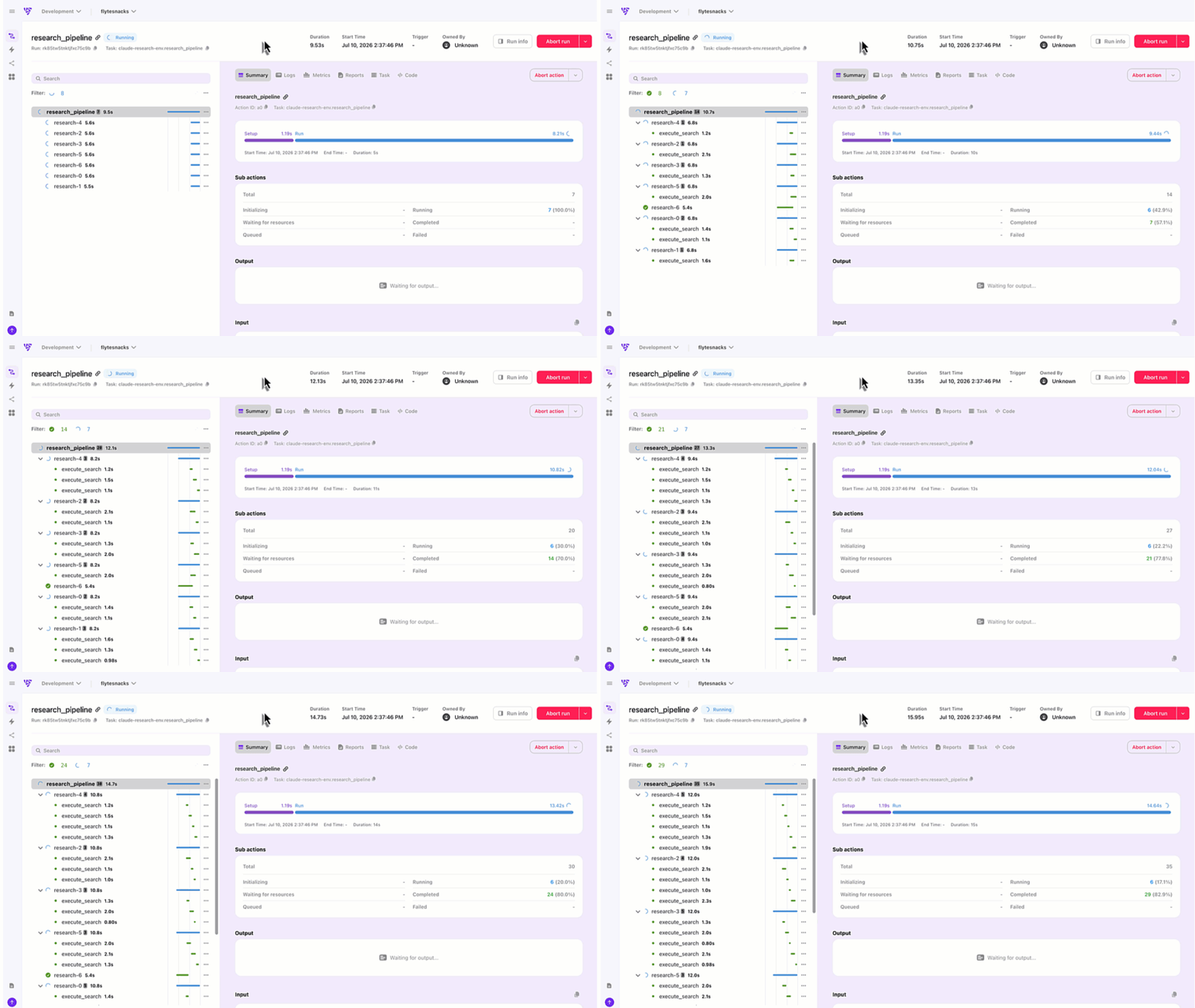
Flyte 2 lets you use asyncio.gather(), the same tool you'd use in any async Python app to fan out tasks in parallel. Each awaited task call becomes a distributed task on your cluster, running in its own container with its own resources.
Basic fan-out with asyncio.gather
import asyncio
import flyte

env = flyte.TaskEnvironment(name="parallel_demo")

@env.task
async def process_item(item: int) -> str:
    await asyncio.sleep(1)  # simulate work
    return f"processed_{item}"

@env.task
async def main(items: list[int]) -> list[str]:
    tasks = [process_item(item) for item in items]
    results = await asyncio.gather(*tasks)
    return list(results)
That’s real parallelism. Each process_item call gets its own container, and they all run at the same time. If you have 100 items, you get 100 parallel tasks. No special syntax, no DSL, just Python.
Limit concurrency with a semaphore
Don’t want to flood your cluster with 10,000 tasks at once? Use a standard asyncio.Semaphore:
@env.task
async def main_throttled(items: list[int], max_concurrent: int = 50) -> list[str]:
    semaphore = asyncio.Semaphore(max_concurrent)

    async def process_with_limit(item: int) -> str:
        async with semaphore:
            return await process_item(item)

    tasks = [process_with_limit(item) for item in items]
    results = await asyncio.gather(*tasks)
    return list(results)
At most 50 tasks run simultaneously. The rest wait their turn. Same pattern you’d use in a web scraper or API client.
Handle errors without losing everything
By default, asyncio.gather cancels everything if one task fails. Use return_exceptions=True to keep the rest going:
@env.task
async def main_resilient(items: list[int]) -> list[str]:
    tasks = [process_item(item) for item in items]
    results = await asyncio.gather(*tasks, return_exceptions=True)

    processed = []
    for i, result in enumerate(results):
        if isinstance(result, Exception):
            print(f"Item {items[i]} failed: {result}")
            processed.append(f"FAILED:{items[i]}")
        else:
            processed.append(result)
    return processed
Kick off runs immediately with create_task
Calling process_item(5) doesn’t start anything. It returns a coroutine that sits until something schedules it and gather() is what does the scheduling. So nothing launches until you reach the gather line, and then you’re stuck there until everything finishes.
asyncio.create_task() hands the coroutine to the event loop right away. The container starts spinning up, control comes back to you, and you await the result whenever you actually need it:
@env.task
async def agent_with_warm_start(question: str) -> str:
    # Both containers start launching now -- no await, no gather.
    index = asyncio.create_task(load_vector_index("docs-v3"))
    tools = asyncio.create_task(warm_tool_sandbox())

    # Meanwhile, do local work. The cluster is already busy.
    plan = build_plan(question)

    # Collect the results only when you need them.
    return await run_agent(plan, await index, await tools)
This is the pattern to reach for when a slow dependency (a model load, an index build, a sandbox warm-up) is needed later in the task but could have started at the top. With gather, that work waits. With create_task, it overlaps.
It also unlocks patterns gather can’t express, like racing coroutines and cancelling the losers.
Stream results as they complete
Don’t want to wait for all 100 tasks to finish before you start processing? Use asyncio.as_completed():
@env.task
async def main_streaming(items: list[int]) -> list[str]:
    tasks = [asyncio.create_task(process_item(item)) for item in items]

    results = []
    for completed_task in asyncio.as_completed(tasks):
        result = await completed_task
        results.append(result)
        print(f"Got result: {result} ({len(results)}/{len(items)})")
    return results
Results stream in as they finish. This is great for reducing downstream work while upstream tasks are still running.
Compose different tasks together
Unlike flyte.map() (which runs the same task on different inputs), asyncio.gather lets you run completely different tasks in parallel:
@env.task
async def fetch_data() -> str:
    return "raw data"

@env.task
async def load_model() -> str:
    return "model_v2"

@env.task
async def pipeline() -> dict:
    data, model = await asyncio.gather(
        fetch_data(),
        load_model(),
    )
    return {"data": data, "model": model}
Two different tasks, running at the same time, results collected when both finish. This is the bread and butter of efficient pipeline design.
Flyte 2 also still offers flyte.map() as fanout method too.
When to use gather vs flyte.map
asyncio.gather() is best when:
You need different tasks running in parallel
You want to stream results with
as_completed()You need flexible composition and error handling
flyte.map() is best when:
You have the same task running on many inputs
You want a built-in concurrency limit (
concurrency=N)You need to work with sync (non-async) tasks
Full async docs: https://www.union.ai/docs/v2/union/user-guide/task-programming/fanout/
See what’s happening in the Flyte Community:
📝 Latest from the blog
Fine-tune an LLM with LoRA & QLoRA in a Flyte Pipeline - Read on union.ai
From Billions to Bytes: The Science of Shrinking Neural Networks - Read on Union.ai
Container-enabled asyncio is all you need (to build Pythonic AI workflows at scale) - Read on Union.ai
Flyte MCP: give your local coding agent control-plane superpowers - Read on Union.ai
🎥 Recent talks & recordings
Building Code Mode Agents - Watch on YouTube
LLM fine-tuning with GRPO - Watch on YouTube
LLM fine-tuning with LoRA & QLoRA - Watch on YouTube
📅 Upcoming events
July 23rd: Seattle Agent Loop Hacknight: Build Agents with Flyte - RSVP on Luma
July 28th: Seattle TwelveLabs + Qdrant: AI Systems for Video Embeddings and Search - RSVP on Luma
🛠️ Releases & updates
Flyte 2 OSS: Backend Devbox and Reimagined UI - Read on Union
June’s release brought first-class agents with memory and tool approval, SDK-authored MCP servers, backoff retries and per-attempt timeouts, multi-pod log streaming, and beta queues and events APIs. - Read the Release notes
🤝 From the community
AI Book Club: RAG with Python Cookbook - RSVP on Luma
Open-Source Text-to-Speech: “Natural” Voices - RSVP on Luma
That’s all for this week! - Sage Elliott